
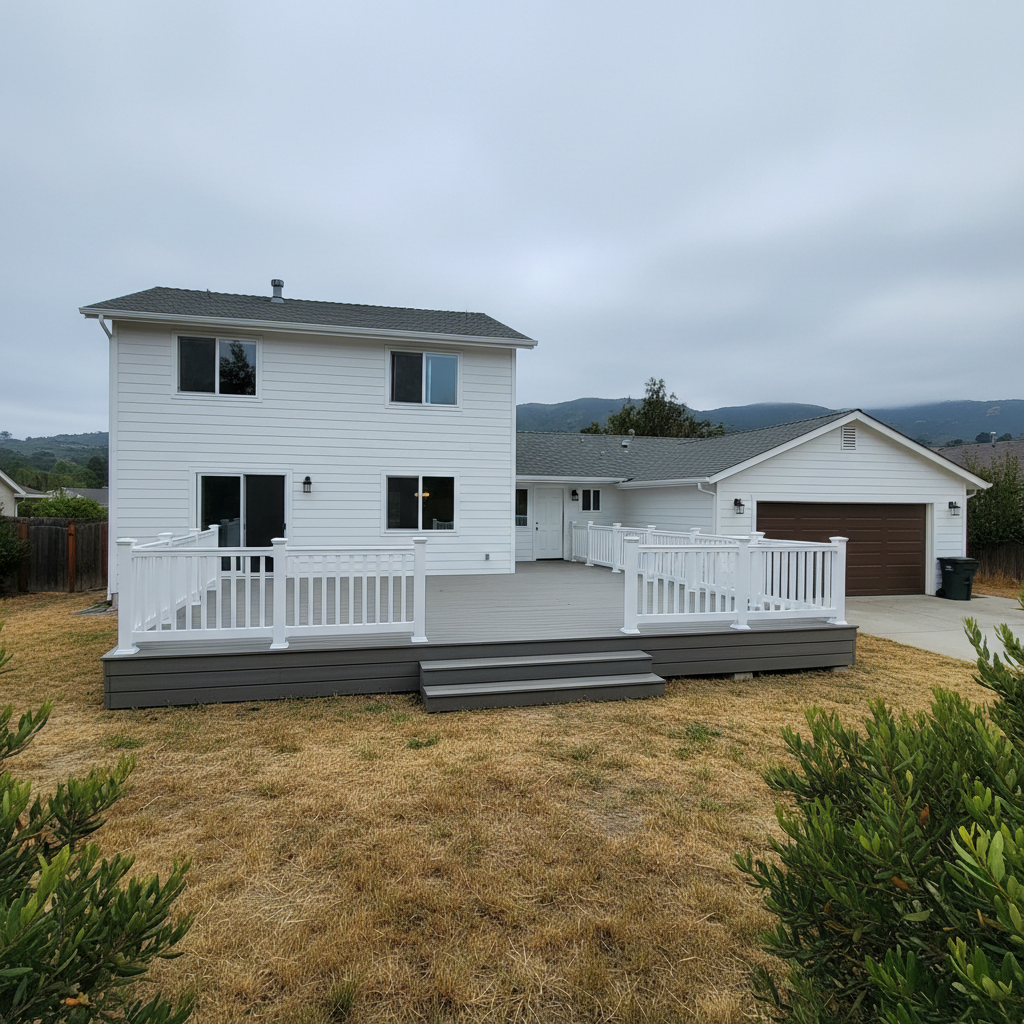
Most people start this search by looking at photos. Photos tell you almost nothing about whether a deck will still be standing square in fifteen years. What tells you something is how the builder talks about your lot, your ledger board, and your permit. Here's what actually separates a deck builder worth hiring from one you'll be calling back in two summers.
Ask about your soil before you ask about stain colors
San Diego County isn't one kind of ground. Near the coast and through places like Pacific Beach or Ocean Beach you're often dealing with sandy soil that drains fast but doesn't hold a footing the same way clay does. Move inland toward Santee, El Cajon, or Fallbrook and you'll run into expansive clay that swells when it's wet and shrinks hard in a dry Santa Ana stretch, which is exactly the kind of movement that cracks an undersized footing over a few seasons. Hillside lots in Mission Hills, Point Loma, and parts of La Jolla bring a third problem: footings set into canyon-edge slopes sometimes need to go deeper or be engineered with piers rather than a simple poured pad. A builder who hasn't asked what your soil does, or hasn't looked at the slope behind your house, is guessing. Footings here generally need to reach undisturbed, load-bearing soil, not just a hole that looks deep enough. That number moves depending on the lot, which is the point, there isn't one answer that applies to every yard in the county.The ledger board is where most failures start
If your deck attaches to the house, the ledger board is the single most important connection in the whole structure. It has to be lag-bolted or through-bolted into the house's rim joist, not just nailed, and it needs proper flashing behind it so water can't get between the ledger and the siding. Skip the flashing and you get rot working invisibly behind the board for years before anyone notices a soft spot. A builder who can describe this step without being asked, who talks about joist hangers rated for the load and bolt spacing rather than just "we'll attach it solid," has actually done this before. One who shrugs past it is telling you something too.Licensing, permits, and what gets inspected
Any deck builder working in California should be able to give you a contractor's license number on request, and you can look that number up yourself on the Contractors State License Board site in about thirty seconds. Decks attached to a house, and most freestanding decks over 30 inches off the ground, need a building permit through the city or county where you live. That permit typically triggers at least two inspections, one for the footings before concrete goes in, and one for framing before the decking boards go down, sometimes a third for the final. A contractor who tells you permits "slow things down and aren't really necessary for a deck" is asking you to take on liability that should be theirs. If your home is in a wildfire interface area, places like Alpine, Jamul, Lakeside, or parts of Poway and Ramona, there are additional material rules under the state's wildland-urban interface code, and a builder working in those zones should know that without you bringing it up first.
If you're in a newer planned community like 4S Ranch, Santaluz, or Carmel Valley, there's a good chance an HOA architectural committee has to approve your deck design before the city permit even gets pulled. Older neighborhoods, think North Park, South Park, Kensington, mostly built from the 1920s through the 1950s, don't usually have that layer, but they come with their own catch: existing additions and decks on these lots were sometimes built decades ago under looser rules, so a repair or replacement job might uncover undersized old footings or a ledger that was never flashed correctly in the first place.
Materials: what actually holds up to this climate
San Diego doesn't have a hard freeze-thaw cycle, so a lot of the damage that wrecks decks in colder states isn't our problem. What we do have is relentless UV. Full sun for most of the year will bleach and check a wood deck's surface even if the wood itself is structurally fine, which is why cedar and redwood decking generally need restaining every 2 to 3 years here, sooner on a south-facing deck with no shade. Composite decking sidesteps that maintenance cycle but gets noticeably hot underfoot in July and August, something worth standing on a sample board for before you commit. Near the coast, salt air corrodes standard fasteners faster than people expect, so hardware should be stainless or coated for a marine environment, not whatever galvanized screws were cheapest that week. A builder who pushes one material without asking where your lot sits and which direction it faces isn't tailoring anything to your house.
Guardrails and spacing aren't optional details
Current California code calls for guardrails at 36 inches minimum on most residential decks, 42 inches in some conditions, and the gaps in railing or balusters have to be small enough that a 4-inch sphere can't pass through, which is the standard meant to keep a small child from squeezing between them. This is one of the few parts of a deck a homeowner can actually check themselves with a tape measure after the fact, so it's worth asking before work starts, not after.
What to walk away from
A bid that's thousands less than every other quote usually means something is getting skipped, often the permit, sometimes the footing depth, sometimes the flashing nobody will see until it fails. Be wary of anyone who wants full payment up front, who can't produce a license number, or who won't put the scope of work in writing. A written contract should spell out materials, footing and joist specs, and who's pulling the permit. If a builder's answer to "who pulls the permit" is "you don't need one for this," that's your answer about whether to hire them.
A deck is one of the few parts of a house where the structure is visible and the failure points are inspectable if you know where to look. Ask the questions above of anyone bidding the job, including Blackstone Outdoor Spaces, and you'll know within ten minutes whether you're talking to someone who builds decks or someone who sells them.